

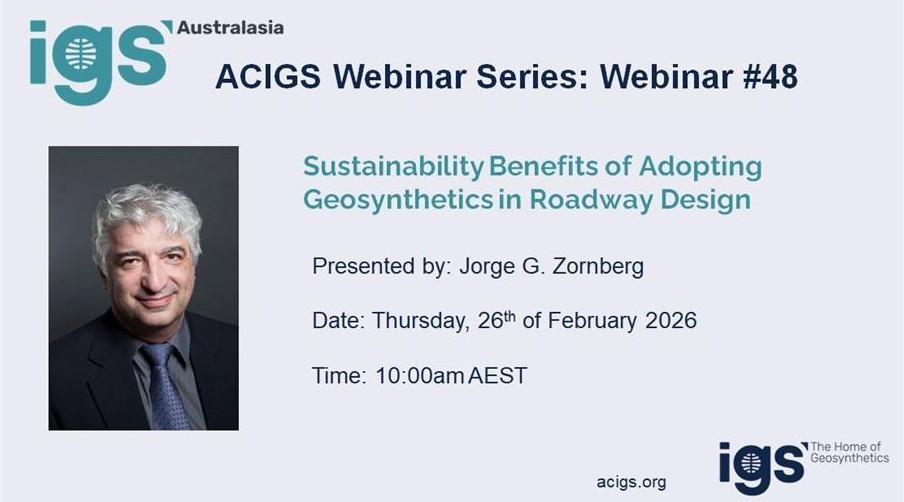
Webinar Summary:
Geosynthetics have provided sustainable alternatives in roadway projects, representing a significant share of total geosynthetic use in civil infrastructure. Yet, given the considerable extension of roadway projects worldwide, geosynthetic products are used in only a small fraction of them. Consequently, the opportunities to achieve sustainability goals by increasing the use of geosynthetics in roadways are substantial. This presentation highlights the sustainability benefits of incorporating geosynthetics into roadway design. This is accomplished by quantifying the carbon footprint of six roadway projects, each involving at least two alternative designs: one with and one without geosynthetics. Specifically, the roadway projects involved the use of geosynthetics to
- (1) mitigate reflective cracking in structural asphalt overlays,
- (2) stabilize unbound aggregate layers,
- (3) reduce layer intermixing,
- (4) reduce moisture in structural layers,
- (5) stabilize soft subgrades, and
- (6) mitigate distress caused by expansive clay subgrades.
The results of the analyses indicate that the design alternatives involving geosynthetics were always more sustainable than conventional (without geosynthetics) alternatives, resulting in savings in the total carbon footprint ranging from 16.3 to 44.44 tCO2e per lane-km (or 11.6 to 50.11% reduction in footprint relative to conventional design alternatives). Overall, the evaluations in this study reveal that an additional reason to adopt geosynthetic solutions in roadway applications is their potential to provide significant sustainability benefits.
Jorge G. Zornberg, PhD., P.E., BC.GE., F.ASCE (Professor and Joe J. King Chair in Engineering. The University of Texas at Austin)
Prof. Zornberg has over 35 years of experience in practice and research in geotechnical and geosynthetics engineering. His research focuses on transportation geotechnics, geosynthetics, unsaturated soils, expansive clays, and environmental geotechnics. As an engineering consultant, he has served as an expert witness in litigation and forensic geotechnical cases. He served as president of the International Geosynthetics Society (IGS). He has authored over 550 technical publications, written several book chapters, and been awarded three patents. Prof. Zornberg has received numerous prestigious awards, including the Presidential Early Career Award for Scientists and Engineers (PECASE) from the President of the United States, as well as the Ralph B. Peck Award, Croes Medal, and Collingwood Prize from ASCE. The IGS established the “Zornberg Lecture,” an honorary